The Iron Triangle of Getting Things Done
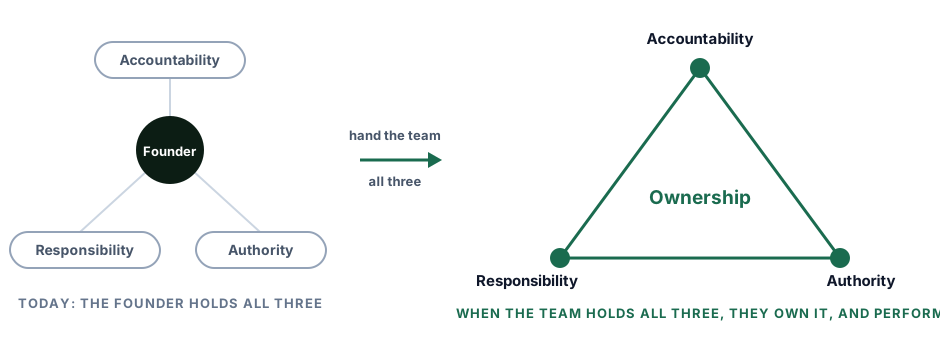
The iron triangle of getting things done is a simple test for why work is or is not getting done: does the person you expect to deliver an outcome hold the accountability, the responsibility, and the authority for it? When they hold all three, they feel ownership and perform at their best. When any one is missing, performance breaks in a predictable way.
The three sides
Accountability means the person answers for the outcome. Not for effort, not for activity, for the result. Everyone involved knows whose name is on it.
Responsibility means the person actually does or directs the work. The outcome is theirs to produce, not to observe.
Authority means the person can make the decisions the outcome requires: spend within a budget, direct people and vendors, change the plan when the plan is wrong.
Held together, the three produce ownership, and ownership is the state in which people perform at their best. The triangle is iron because removing any one side collapses the other two.
How each missing side breaks performance
Missing accountability. The person has the work and the power but does not answer for the result. This produces activity without urgency: busy teams, full dashboards, and no one who feels the miss when the number is missed.
Missing authority. The person answers for the result and does the work but cannot make the decisions the result requires. This is the most common gap, and the most corrosive. It looks like underperformance, but it is structural: the person is being graded on outcomes they were never empowered to control. Strong people leave over this.
Missing responsibility. The person answers for the outcome and holds the power but does not actually do or direct the work. This is delegation on paper. The work quietly routes back to whoever is really doing it, usually the founder, and the org chart stops describing reality.
Why founders should care
Founder dependency is the triangle concentrated in one person. The founder answers for growth, does the critical work, and holds every meaningful decision. That configuration built the business, and it also caps it: the company cannot grow faster than the founder's calendar.
The fix is not hiring more people and hoping. It is handing the team complete triangles, outcome by outcome: the accountability, the responsibility, and the authority together. Handing over two out of three does not create ownership. It creates the failure modes above, and then the conclusion that the team was not ready, when the structure was never complete.
Using the triangle as a diagnostic
When an outcome keeps slipping, run the test before changing the people. For the outcome in question, write down one name for each side of the triangle. Three matching names is ownership. Three different names is a committee. A blank is the actual problem.
This lens is part of how State of Mind Strategies evaluates the people, vendor, and accountability layer of the Commercial Growth Model. Growth constraints that look like marketing problems or talent problems are often incomplete triangles, and completing the triangle changes performance without changing the team. It applies to vendors as well: an agency with responsibility but no clear accountability, or accountability but no authority over its scope, behaves exactly like an employee in the same position.
Frequently asked questions
What is the iron triangle of getting things done?
The iron triangle of getting things done is a delegation framework developed by Zachary Leifer, founder of State of Mind Strategies. It holds that a person performs at their best when they have all three of accountability, responsibility, and authority for an outcome. When they hold all three, they feel ownership. When any one is missing, ownership breaks and performance suffers.
What happens when one side of the triangle is missing?
Each gap produces a recognizable failure. Responsibility and authority without accountability produces activity that no one measures. Accountability and responsibility without authority produces frustration, because the person answers for results they cannot control. Accountability and authority without responsibility produces delegation on paper only, with the work still routing back to the leader.
How does this relate to founder dependency?
Founder dependency is usually the triangle concentrated in one person. The founder holds the accountability, the responsibility, and the authority for growth, so the team executes tasks without owning outcomes. Handing the team all three sides, deliberately and per outcome, is how growth stops depending on the founder's calendar.
How is the triangle used in an engagement?
It is a diagnostic lens. When a team is underperforming, the first question is not whether the people are good. It is whether anyone actually holds all three sides of the triangle for the outcome in question. In practice, the answer is often no, and redistributing the three sides changes performance without changing the team.
Is growth waiting on an incomplete triangle?
A discovery call is a focused conversation about how growth works in your business today, including who actually owns it.